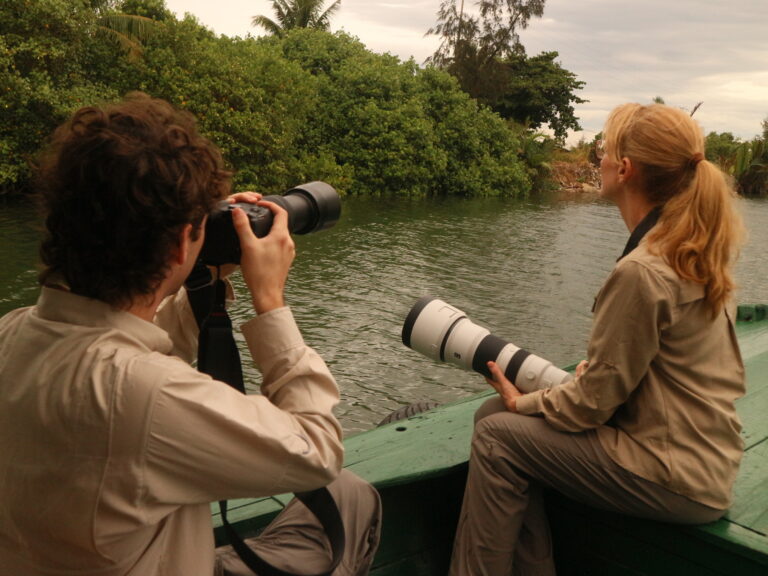
In October 2025, we were due to led a specialist primate tour with a couple from Turkey. It was going to be their first time visiting Southeast Asia but due to the ongoing weather issues, our guests requested to postpone their trip until April 2026. Deciding to make the most of this opportunity, two of our guides Thanh and Huy (two of our core lead guides from Da Nang who run majority of our specialist primate tours in this part of the country) decided to use this time to do a specialist research trip, following almost the same route but with the goal of tracking down some new sites, trying out some new equipment and in general, having a bit of fun.
The original itinerary included all of the usual highlights of a Central to North Vietnam Trip, such as Red-shanked Douc Langur, Delacour’s Langur, Hatinh Langur, but also more specialist targets rarely offered on other primate tours, including Southern White-cheeked Gibbon, Northern White-cheeked Gibbon, Northern Pygmy Slow Loris and Assam Macaque (to name a few!). The main part of the tour was due to follow a rather rapid 7-day itinerary that was loosely based off a combination of our existing primate and mammal watching tours, followed by a 4-day extension for Northern White-cheeked Gibbon.
Day 1:
After a quick bite for breakfast, our trip began in Da Nang with a visit to Son Tra Nature Reserve for Vietnam’s most iconic and best-known primate, the Red-shanked Douc Langur. The morning started out drizzling but soon cleared around 8.00am. No sooner had that sun come did we encounter our first big group of Red-shanked Douc Langur. Over the next hour of the morning we had several encounters with different family groups, including a big male who considerately sat in perfect light at eye-level down one of our new tracks. A quick detour to the southeast corner let us add Rhesus Macaque to the trip list as well as several migrant birds such as Taiga Flycatcher, Olive-backed Pipit and Forest Wagtail.

Around midmorning we departed north to Bach Ma National Park arriving around lunchtime. It was quiet for mammals on the way up to our accommodation, but we did add our first Pallas’s Squirrel and saw several nice birds such as Green-eared Barbet, Lesser Laughingthrush and Barred Cuckoo Dove.
Just before we arrive at the accommodation, Huy spotted a flash of movement in the trees slightly off the road at one of the valley corners. Wow! It was a Black Giant Squirrel (Ratufa bicolor). This is one of the largest squirrel species in the world and by far one of the best looking. They have a tendency to run and haul themselves from tree to tree making for great watching.

After an early lunch, we headed down to our usual spot to look for Northern Yellow-cheeked Gibbon. On the way we were walking on the tracks and we suddenly spotted a Stump-tailed Macaque sitting on a rock on edge of the forest. We were able to get some nice but distant views that we cropped a lot for photography before it continue on into the forest. This is a species we’ve been encountering more and more regularly in some parts of Bach Ma, so hopefully it’s becoming more and more reliable in these locations.

We reached our Northern Yellow-cheeked Gibbon spot on dusk. We’ve been having a tougher run of this species in the last two months, only recording them around 50% of the time (which we admit is still pretty good for this critically endangered and range restricted species!). Unfortunately today they once again avoided us, though we heard the family group not particularly far away. In typical fashion, our principal herping guide Tung, went out the next day on a two-day herping tour and got spectacular views of the group but of course, only had his macro lens setup with him! To even the score, we’ve been recorded the incredibly rare Impressed Tortoise on several of our mammal-watching tours in recent months (much to his jealousy!), so it all balances out in the end. Teamwork!
Despite missing the gibbon we were rewarded with a Small-toothed Ferret Badger along one of the main trails making for an exciting bonus species. This species is becoming (almost) guaranteed on our Bach Ma trips, so it feels like greeting our old friends. He was quick though, so I only got this simple photo.

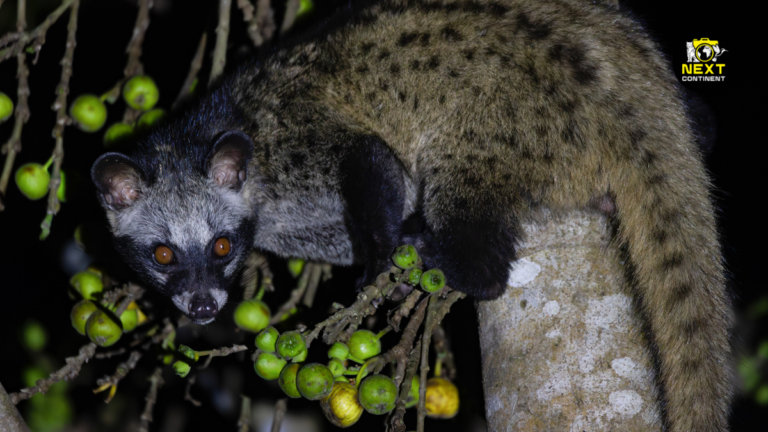
After dinner, we went for a quick spotlight. After having such great encounters, the last few weeks (see our recent trip reports here and here) our expectations were high, but it was a reasonably quiet night. However, even though quantity was down, rarities were up and we had a good look at Pygmy Slow Loris (Our fourth primate for the day, fifth if you count hearing the gibbons), as well as a very nice Northern Woolly Horseshoe Bat and a very brief Indochinese Palm Civet, which is what we encounter the most here. A Mountain Scops Owl was a nice pick up on the way back.

Day 2:
The next morning, we were up early preparing to transfer to Phong Nha Ke Bang, a further 4-5 hours further north. We once again tried for the Northern Yellow-cheeked Gibbon, but this time didn’t even hear them. For those planning a trip, we have a much better run with this species from mid-Winter through to early Summer typically so keep that in mind when getting in touch with us. On the drive down, we added Cambodian Striped Squirrel to the list and saw two more Red-shanked Douc Langur groups.
Today was mainly a travel day and after a morning in Bach Ma, we took our time travelling north, stopping along the way for a few meal breaks and coffee.
We pulled into our hotel just before dusk. Unfortunately a real downpour had set in, so we decided to have an early dinner and try to wait for the rain to stop or turn to just a drizzle before spotlighting! Normally we target a variety of civets, flying squirrels and Mainland Leopard Cat here, so fingers crossed as we headed out.
In expected fashion, the rain did not help the mammal watching, but we did have a great run of snakes and frogs. To start, we got a big, beautiful snake crossing the road. Pulling over, we saw it was Boiga multomaculata (Many-spotted Cat Snake), a mildly venomous snake and considered not harmful to humans. We often recorde this species out on wet or rainy nights as the rain makes them extra active and encourages them to move about.
After about an hour we found a Small-toothed Palm Civet, sitting high up in a tree looking very miserable and sad in the rain. The red-light torch seemed to be the final straw for the night as he disappeared inside a rotting hollow and ignored us.
Unfortunately after this the rain really kicked up badly, so we decided to call it a night. On the way back, the snake gods continued to deliver and we found a gorgeous Hypsiscopus murphyi (Murphy’s Mud Snake). This is a super cute species, with a chubby, short body and vibrant yellow belly. It’s always super popular, doesn’t matter if we want it on a birding, herping or mammal tour, everyone loves it.

Day 3:
The next morning, we were up early and ready to hit the park. Phong Nha Ke Bang is an incredibly underrated mammal and primate watching site and often skipped by visiting wildlife watchers. Up at 5.00am, we had several targets including Red-shanked Douc Langur (you can never have too many!), Hatinh Langur, Assam Macaque and the critically endangered (and incredibly difficult to see) Southern White-cheeked Gibbon.
We started with a more than 30km drive into the park. Even though it was still dark, we enjoyed the atmosphere of the national park, made all the better with coffee. As it slowly got brighter, we enjoyed spectacular views of the valley, mountains and the clouds floating throughout. Heaven on earth for us.
An early start is very important when targeting most of Vietnam’s gibbon species, as it’s the highest chance of hearing them sing, which is the best way to locate them. Whilst searching for them, we spotted three different families of Red-shanked Douc Langur, all with around 8~ members each. There were even a number of babies clinging onto their mother’s belly, always perfect for photography.

After many hours of searching, we decided to wrap up and travel back for lunch. Southern White-cheeked Gibbon are really tough, probably the toughest in Vietnam at the moment! Just as we thought our luck had run out, we were travelling down the hill, right past a nice clear limestone peak, when suddenly right in front of us was a Hatinh Langur! We jumped out to have a good look and to snap some photos, the perfect way to end the morning.

After lunch, we took a nap to recover and prepare for a big afternoon and night of spotlighting. After our break, we took one of our other roads that heads more-or-less directly west towards the Laos border. This can be a great spot for Macaques. Along the way, Huy heard some macaques calling and so we stopped besides the road. Within a few minutes a whole troop of Assam Macaque came into view, climbing through the jungle and crossing the road. It was a huge troop, around 20~ individuals. A spectacular encounter with one of the tougher-to-see Macaque species in Vietnam. Another target complete!
Near the Laos border, we caught up with a ranger friend of ours who offered some tips on recent sightings of Mainland Leopard Cat and a few other creatures, which we’d try later that night. Otherwise, it was relatively quiet besides a few nice bird species such as Blyth’s Paradise Flycatcher, Asian Fairy Bluebird and Black-crested Bulbul to name a few.
On dusk, we pulled up near our spotlighting trail and had a light dinner, listening to the forest and natural park slowly turn from day to night. Despite our best efforts, it was a bit of a poor night. Though, they say sometimes one epic species can save a trip! About halfway through the night we found a Common Giant Flying Squirrel, which sat perched in a tree before leaping out and spreading his large wings, a spectacular sighting for our group. Other than that, we saw some spots of eyeshine here and there, but nothing we could connect with. Still, we had seen 3x primate species today, including two new ones, so we went to bed happy.
Day 4:
Day four started early with some Banh Mi and coffee as we headed back into the depths of Phong Nha Ke Bang’s magnificent mountain forests. Today, something felt extra special in the air, don’t ask me what, but it was going to be one of those memorable days, I just knew it somehow.
First up, we were back on task for the Southern White-cheeked Gibbon. We had spent most of yesterday morning working on this species (without success), but were back again in our most reliable spots to see if we could give them another shot. Eventually, our efforts were completely worth it. Whilst I was chatting with Huy, we suddenly heard iconic sound of the gibbons beautiful singing coming immediately from the hills on the left side of the road. This was a good spot for them, so we pulled over and had another listen. Yes! That was their song! We were all so excited just to be able to hear them that we both erupted in big beaming smiles.
For the next half an hour, we stayed around this corner of mountain forest, listening to their beautiful songs. Every now and then, we saw a cluster of leaves shake as an animal had just leapt through them, but no sightings. Then the moment came. Huy suddenly spotted a beautiful adult male SOUTHERN WHITE-CHEEKED GIBBON come swinging into view, passing from tree to tree in the canopy along the crest of the hill. The vision was a little foggy, but still we could see the animal very clearly through the binoculars.

For the next fifteen minutes, we enjoyed this adult male (probably the group’s leader), swinging around, hanging and calling. We could hear other members of the group and after another quarter of an hour a second male came swinging into view! Unbelievable!
It’s hard to put into words just how special and rare these encounters are. There are six gibbons in Vietnam, of which only one is easily seen (the Southern Yellow-cheeked Gibbon in Cat Tien National Park — especially on our Morning with the Gibbons tour!). Beyond that, we are the only company that offers tours for the other three species (both Cao Vit Gibbon and Northern Black-crested Gibbon are protected by law from tourism). The Northern Yellow-cheeked is our next most reliable, recorded semi-regularly in Bach Ma National Park and other parts of the Annamite Ranges. Then, we also run tours to see the critically endangered Northern White-cheeked Gibbon in Van Ho, but this species still requires a 3-4 day trip. Finally, this Southern White-cheeked Gibbon was once somewhat reliable but in the last decade has become next to impossible. We always target when visiting Phong Nha Ke Bang, particularly on our Hatinh Langur tours, but rarely encounter them, let alone this well. Such an extraordinary morning and something our entire team is still buzzing about.

After a momentous 30 minutes, the gibbon party moved on. On our way back, we encountered a big number of Red-shanked Douc Langur as well as a big male Assam Macaque crossing the road near the botanical gardens. A three-primate morning and it wasn’t even 10.00am yet!

After an early lunch, it was time for us to transfer to Đồng Lê in Tuyên Hoá, north of Phong Nha Ke Bang National Park. Tuyên Hoá is a conservation area for the critically endangered and much sought-after Hatinh Langur. Though we had already seen this species whilst in Phong Nha Ke Bang, we have an ongoing relationship with the wonderful Mr Tu and the local conservation group and had set aside the following day to visit the team and catch up with this extraordinary population of primates.
We arrived in Đồng Lê at dusk and were welcomed by Mr Tu and his family, the leader of the conservation team. That night, we all stayed overnight at his house and had dinner with his whole family. It is always a great time to meet and share with local people about conservation, culture, wildlife, illegal activities and more. Not only is it great to support people doing this kind of amazing work, but it’s a great way to involve our guests with conservation work happening live on the ground and really meet the people involved in its progress. Mr Tu and his group are masters of this area, which is why we are thrilled to be able to cooperate together to observed these incredible langurs.
Day 5:
Early morning the next day, we were led by Mr Tu and another lady from the conservation team. The weather was a bit cloudy and unfortunately it threatened with rain on and off all morning, not ideal for photography. In total, there are around 6 mountains and limestone peaks that the Hatinh Langur can be reliably seen. We separated into two groups guided by Tu and his partner to scan the area, covering a larger area to increase our chances to spot the langur. I went with Mr Tu, whilst Huy went with the other lady. After 40mins, Mr Tu and I got a call from Huy, say they had successfully found the troop and that they were very close, perfect for photography! Awesome!

When we arrived, we could see Huy watching four Hatinh Langur eating in the bushes at the base of the limestone. All black bodies, with long tails, ebony face and distinctive hair crest, white moustache and nape, they’re an amazing primate. When we arrived, the monkeys detected us and jumped into a neighboring tree, staring down and posing perfectly for photos. Unfortunately, right at the very moment, it started to downpour. Out came the raincoats, but there is only so much you can do during this kind of rain. After around 15 minutes, the rain stopped and we looked up to see a big group of 9x Hatinh Langur all sitting up beautiful in a tree, drying off in the weak sun. Spectacular!

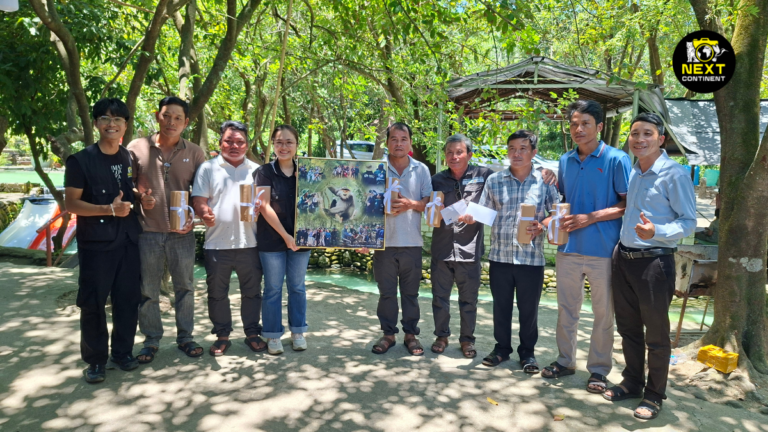
After a successful and magical morning, we made our donation on behalf of Next Continent to the group to support their ongoing conservation work, took a few group photos and said goodbye to Mr Tu, his team and his family — looking forward to seeing you again soon!
It was time to travel to the North, with Cuc Phuong National Park waiting for us as our next destination.
It’s a long trip to Cuc Phuong, so the rest of the day was rather uneventful. When we arrived at the park, it was already dark. On the way to our accommodation we picked up two snakes, a White-lipped Pit Viper and a gorgeous Asian Sunbeam Snake, right near Mac Lake.

The plan had been to check in and go for a short spotlight, however we were very tired after a long drive, so we decided to take it easy, recover with a well-earned rest and hit the ground first thing tomorrow.
Day 6:
Today was a bit more of an easy day. Our main mammal target was the Northern Pygmy Slow Loris, a nocturnal species, meaning we had the days to do a bit more leisurely wildlife watching through the park.
After a nice breakfast, we took a nice walk around Mac Lake and began travelling towards the Bong Substation. Along the way, we had great views of Pallas’s Squirrel and a single Maritime Striped Squirrel, adding nicely to the mammal trip list. Some nice highlight birds including Large Scimitar Babbler, Limestone Leaf Warbler, Asian Barred Owlet and White-browed Piculet.

After our walk, we travelled to some of the caves to check out some of the bat roosts. For those that have done this before, will know that it can be a bit challenging with the stairs, as it’s very steep and slippery. There are a number of caves and bat roosts in the park, making it a major location for serious mammalwatchers. Over our visits, we have now recorded and identified around a dozen species. When we arrived the roost areas, we switch on the red-light torches and began to scan.
As always, there were hundreds of bats. Despite the big numbers, identification of these species is a whole other challenge. We took our time trying to observe and identify as many species as we could. Amongst the groups we were able to pick out Intermediate Roundleaf Bat (Hipposideros larvatus) and a handful of Lesser False Vampire Bat (Megaderma spasma), both of we which we almost always record here. We also have images of another Old World Roundleaf Bat, which we are pretty sure are Exotic Roundleaf Bat (Hipposideros gentilis), which we’ve recorded here a few times as well as a few other individuals. But we’re waiting for some input from some of our colleagues who are experts when it comes to bat identification. Due to timing, we skipped the usually easy to see Grand Roundleaf Bat colony in one of the other caves.

Following dinner, we began our spotlighting session from Mac Lake at around 7.00pm, then headed towards Bong Substation around 16kms away. This is where the night gets interesting, so hold on!
Whilst driving, we were slowly scanning both sides of the road with our torches, searching for eyeshine or movement as we went. Very deep into the forest, we spotted a flash of movement along the side of the road. We pulled over and lit up the area, quickly picking up a reflection. There in scrub staring back at us, was an OWSTON’S CIVET! Unbelievable! This is by far one of the most highly-sought after species in Indochina and certainly a MASSIVE target for our visiting wildlife photographers and mammal watchers. We quickly got a good but very brief look at this amazing species before it slunk off into the forest. This was our first sighting of this species in almost a year and though brief, was one of our best looks ever. An incredible start and alongside the Southern White-cheeked Gibbon, has quickly propelled this trip into one of the best ever for us!
Continuing on we reached one of our Northern Pymgy Slow Loris spots. We wandered around this area for around 45 minutes and picked up the bright orange and distinctive eyeshine of this species. But unfortunately on both occasions the animals slipped away avoided a clear look. Frustrating! But you can’t complain after having Owston’s Civet out in the open!!
After another quarter of an hour, we decided to go to one of our other Slow Loris spots to see if the animals would be better behaved there. This is a long forest trail that goes much deeper into the jungle, taking around 4-6hrs to complete. Not super practical for extended spotlighting, particularly with many steep stone steps and trail off-shoots.
For the first hour, we walked around 1.5km. On the way we encountered our third Northern Pygmy Slow Loris for the evening, hiding away in typical mixed bamboo and evergreen forest habitat. This time we get a look but regretfully, it was through a lot of branches and leaves, making it very obscured. As compensation, we had a great look at both Mountain Scops Owl and Oriental Bay Owl, the Bay Owl in particular is always a major sighting! On the way back, we got our first Mekong White-bellied Rat, which ran up across a log and down the trail ahead of us.

Still very keen on seeing what else we could find, we changed plans again and decided to try another trail of ours which is a long a much bigger and more open road. Immediately we picked up Collared Scops Owl (our third owl species of the night!). Finally, after walking this trail for around 20minutes, we picked up the iconic bright orange eyeshine of more Northern Pygmy Slow Loris. This time we were able to sneak up and observe it really clearly under redlight! Success! Almost straight away after this we got a second animal, making it a total of 5x Northern Pygmy Slow Loris in last 2.5hrs approximately, a very good run for us!
Before the night ended, we had one more surprise with an amazing Masked Palm Civet which casually trotted through the forest and across the road allowing for great views and a few quick photographs. Our fourth civet species for the trip! Now it was time to head back to accommodation and call it a night, after a very very successful night!

Day 7:
This morning we were up early and departing Cuc Phuong National Park at around dawn. We had a short drive to Ninh Binh and Van Long Nature Reserve where we would target our 10th primate species in 7 days, the critically endangered Delacour’s Langur (as per our original itinerary).
We arrived in perfect light and immediately met Trang one of our guides who is based in Ha Noi. She was leading her own bird tour the same morning. She was kind enough to let us crash her tour and be bonus guides. The guest was very happy, three guides for the price of one! So we had a quick catch up and got under way.

We began with a boat cruise on a same sampan through the wetlands that runs amongst the limestone karst cliffs and forest. Whilst waiting, we did a little bit of birding and saw all the regular species, Little, Medium and Great Egret, White-browed Crake, Grey-headed Swamphen and a handful of White Wagtail.
Soon we were off, heading due course to some of the best spots for Delacour’s families. This species of primate is best seen early morning, when they come out to feed in the foliage of the forests that line the karst. Within 15 minutes, we rounded a bend a straight away spotted our first Delacour’s Langur, effortlessly climbing up the limestone cliff in that distinctive way that they did! Success! Our 10th primate species down, we were all so happy! Also a very exciting lifer for Trang’s guest. Everyone wins!

We watched our monkey climb up, sit a bit in the sun before bounding out of sight. As we went continuing on, we added Asian Openbill, Grey Heron, Purple Heron and White-throated Kingfisher to the trip list. We hadn’t gone very far when Trang suddenly spotted another nice big troop of around a dozen Delacour’s! Together, we have spectacular views of a lovely big family group, including a bright orange baby that was jumping around in the vines and seeming to be bothering all the adults who were just trying to feed. An amazing morning.
We looked for Assam Macaque which we also usually find at Van Long but didn’t have any luck today. Luckily we had seen this one several times very well back in Phong Nha Ke Bang. After a quick lunch (and another Pallas’s Squirrel in the garden), it was time to continue on to Ha Noi and take a long big rest.
I want to thank Huy for joining me on this trip and the Next Continent team for helping us have a special research trip, we really appreciate the opportunity to be able to refine our trips and discover new things. We can’t wait to lead these trips again soon!
Want to see more highlights from this trip? Check out this video: https://www.youtube.com/shorts/U5U1vdpP_oI
Want to book your own Custom & Specialists Primates & Mammal tour? You can learn more about it here: https://nextcontinenttours.com/vietnam-primate-watching-tours/. For information about our Vietnam-wide Mammal & Primate Tours, please visit: https://nextcontinenttours.com/vietnam-mammal-tours/
SPECIES LIST:
Primates:
- Northern Yellow-cheeked Gibbon (Nomascus annamensis) — Heard Only
- Southern White-cheeked Gibbon (Nomascus siki)
- Delacour’s Langur (Trachypithecus delacouri)
- Hatinh Langur (Trachypithecus hatinhensis)
- Red-shanked Douc Langur (Pygathrix nemaeus)
- Assam Macaque (Macaca assamensis)
- Rhesus Macaque (Macaca mulatta)
- Stump-tailed Macaque (Macaca arctoides)
- Pygmy Slow Loris (Xanthonycticebus pygmaeus)
- Northern Pygmy Slow Loris (Xanthonycticebus intermedius)
Other Mammals:
- Northern Woolly Horseshoe Bat (Rhinolophus luctus)
- Intermediate Roundleaf Bat (Hipposideros larvatus)
- Exotic Roundleaf Bat (Hipposideros gentilis) — To Be Confirmed, hopefully!
- Lesser False Vampire Bat (Megaderma spasma)
- Black Giant Squirrel (Ratufa bicolor)
- Pallas’s Squirrel (Callosciurus erythraeus)
- Cambodian Striped Squirrel (Tamiops rodolphii)
- Maritime Striped Squirrel (Tamiops maritimus)
- Common Giant Flying Squirrel (Petaurista philippensis)
- Indochinese Palm Civet (Paradoxurus hermaphroditus)
- Masked Palm Civet (Paguma larvata)
- Small-toothed Palm Civet (Arctogalidia trivirgata)
- Owston’s Civet (Chrotogale owstoni)
- Small-toothed Ferret Badger (Melogale moschata)
- Mekong White-bellied Rat (Niviventer mekongis)