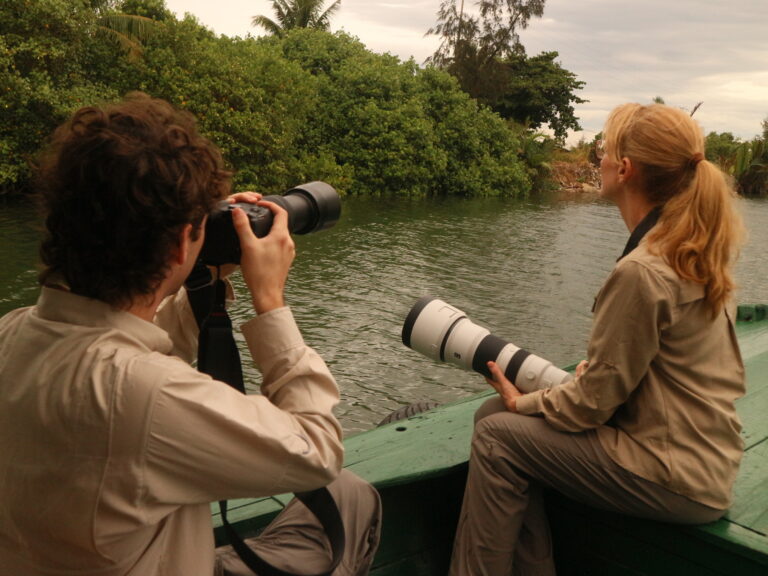
We departed from the pier at 5:30 AM, just as the first light spilled across the Thu Bon River. The morning was still and golden, with excellent conditions for scanning the mudflats and exposed sandbars as the tide receded. As the boat cruised quietly through the waterways, birdlife quickly emerged from all directions.
Shallow mudflats hosted a variety of waders. A lone Eurasian Whimbrel was observed foraging along the shoreline. Its distinctive head stripe and moderately long downcurved bill helping distinguish it from the larger Eurasian Curlew. Nearby, a single Spotted Redshank stood out with its slim shape, longer dark bill, and soft grey plumage, noticeably more refined than the Common Redshank. Looking through the different areas, dozens of Red-wattled Lapwings patrolled the open flats, while White-breasted Waterhens skulked along the edges of dense reeds.
Heron colonies were lively this morning, we noted around 30 individuals of Little Egrets, including three active flocks, alongside around 15 Medium Egrets, easily recognised by their shorter necks and yellow bills. A tall and imposing Great Egret stood out with its long S-shaped neck, while a solitary Little Heron hunted quietly along the riverbank. Early in the cruise, we also encountered small groups of ducks, including Lesser Whistling-Ducks (6) and Indian Spot-billed Ducks (4), gliding through the calmer stretches of water.


As we approached transitional habitats – scrubland and mangroves, bird diversity increased further. We recorded a single Asian Green Bee-eater, a vibrant bird with a blue throat, and one Blue-tailed Bee-eater, perched on a wire with long tail streamers and a yellow throat. Three Long-tailed Shrikes scanned the grasslands from exposed perches. A Racket-tailed Treepie flashed its long, elegant tail as it moved through riverside trees. Kingfishers were among the stars of the cruise with: five White-throated Kingfishers, eight Pied Kingfishers actively hovering and plunging into the water, and one Common Kingfisher.
As the river carried us past small villages and patches of urban forest, we encountered a mix of resident species. These included Sooty-headed Bulbuls (5), Masked Laughingthrushes (4, heard only), Black-collared Starlings (2), White-shouldered Starling (1), Common Mynas (2), House Sparrows (4), and Eurasian Tree Sparrows (6). Overhead, two Large-billed Crows crossed the sky while around 20 White-nest Swiftlets and 10 Asian Palm Swifts hovering above us. Additional sightings included Red Collared-Doves (2), Spotted Doves (6), Zebra Doves (8), Greater Coucals (2), Paddyfield Pipit (1), and another Racket-tailed Treepie (1).
By 9:00 AM, as temperatures began to climb, bird activity gradually slowed and we concluded the cruise, returning to the pier with a total of over 40 species recorded.

If this report inspires you to explore the Thu Bon River for yourself, we’d love to welcome you aboard. The Hoi An Birding Cruise is ideal for travelers with limited time, families seeking a nature-based experience, and dedicated birders searching for lifers.
For inquiries or custom birding itineraries, please contact us – our team is happy to help you plan a memorable adventure in the heart of Central Vietnam.