For many people, the idea of discovering a new species of primate sounds like something from the 19th century. Surely every monkey and ape on Earth has already been found?
Remarkably, that’s not the case.
A newly published paper in the Vietnamese Journal of Primatology has described what researchers believe to be a previously unknown species of limestone langur from central Laos: the Short-tailed Langur (Trachypithecus brevicaudus).
A Langur in the Limestone
The proposed new species inhabits the rugged limestone karst forests of Bolikhamxai Province (Laos), one of Southeast Asia’s most spectacular yet least explored landscapes. Scientists have suspected for years that unusual langurs might exist in this region. Hunters, local villagers and occasional wildlife observers had reported monkeys that didn’t quite match any known species, but evidence remained frustratingly limited.
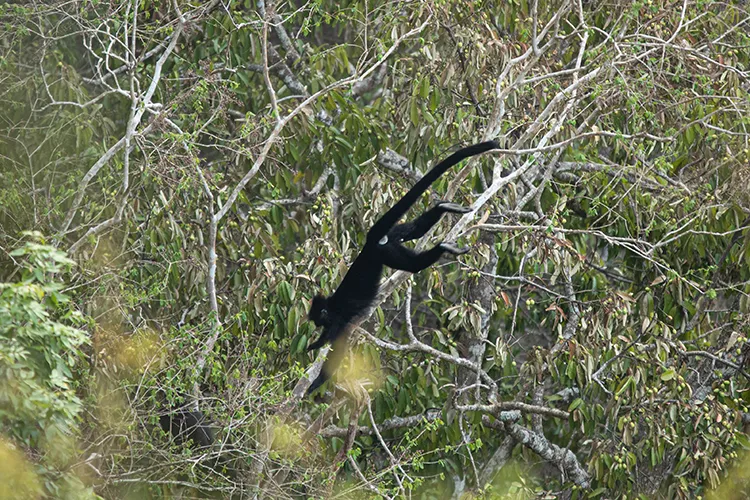
That began to change when photographs taken by members of the Saola Foundation (one of our conservation partners) and later by subsequent survey teams revealed what appeared to be a langur unlike any previously described species. To read the original posts and announcement, please visit the Saola Foundation website at this link: https://www.saolafoundation.org/new-species-of-leaf-monkey/
What Makes It Different?
At first glance, the animals closely resemble the black morph (ebenus) of the Hatinh Langur (sometimes referred to as the Indochinese Black Langur). However, closer examination revealed a combination of characteristics not seen in any recognised limestone langur.
The most obvious features are exactly what give the species its name:
- A noticeably shorter, stouter tail
- A significantly thicker tail
- Otherwise very similar black coloration to closely related limestone langur species
Researchers measured body proportions from multiple photographs and found that the tail was consistently 11–15 centimetres shorter than those of the Hatinh Langur and Lao Langur. The species has therefore been named Trachypithecus brevicaudus, from the Latin brevis (short) and cauda (tail).
One of the most interesting aspects of the paper is how the species has been described. Traditionally, describing a new mammal requires a physical type specimen, and today genetic evidence is generally expected. In this case, researchers had neither.
Instead, the description relies on:
- Repeated photographic evidence
- Clear morphological differences
- Observations collected over multiple field surveys
- Comparisons with closely related limestone langur species
The authors argue that modern conservation laws make collecting specimens from highly threatened mammals increasingly difficult, and that exceptionally clear photographic evidence can, in some circumstances, provide sufficient justification for recognising a new species. Whether the wider scientific community ultimately accepts this approach remains to be seen.
Why This Discovery Matters?
If widely accepted, the Short-tailed Langur would become yet another reminder that Indochina (and the Annamite Mountains in particular) remains one of the world’s greatest frontiers for mammal discovery. Ironically, newly discovered species are often already among the world’s rarest. The known population of the proposed Short-tailed Langur appears restricted to just two limestone areas in central Laos, neither of which currently has full protected status. Although the authors suggest the species would likely qualify as Endangered, others, including the Saola Foundation, believe its extremely restricted distribution could ultimately warrant a Critically Endangered assessment once more information becomes available.
How can I help?
While the scientific discovery is exciting, perhaps the most important work is only just beginning. Confirming the species, understanding its distribution, working alongside local communities and securing legal protection for its remaining limestone forests will require years of dedicated conservation effort.
The Saola Foundation has been at the forefront of this work for many years, combining rigorous scientific research with practical, on-the-ground conservation throughout the Annamite Mountains. Every contribution helps fund field surveys, community engagement, habitat protection and the conservation actions needed to give one of the world’s newest (and potentially rarest) primates the best possible chance of survival.
At Next Continent, we’re proud to support organisations like the Saola Foundation and believe that responsible ecotourism can play an important role in protecting species like this. Every guest who joins one of our conservation-focused wildlife tours helps contribute to projects working to safeguard Southeast Asia’s extraordinary biodiversity.